
Painting a Future at Risk
In April 2019, I held what remains the most ambitious and meaningful project of my career a solo exhibition at the National Art Gallery of the Maldives titled A Vulnerable Beauty: Maldives. This body of work, created over a year and a half, focused on climate change, sea level rise, and the environmental vulnerability of island nations. I created a series of 31 artworks focused entirely on the theme of climate change and sea level rising.
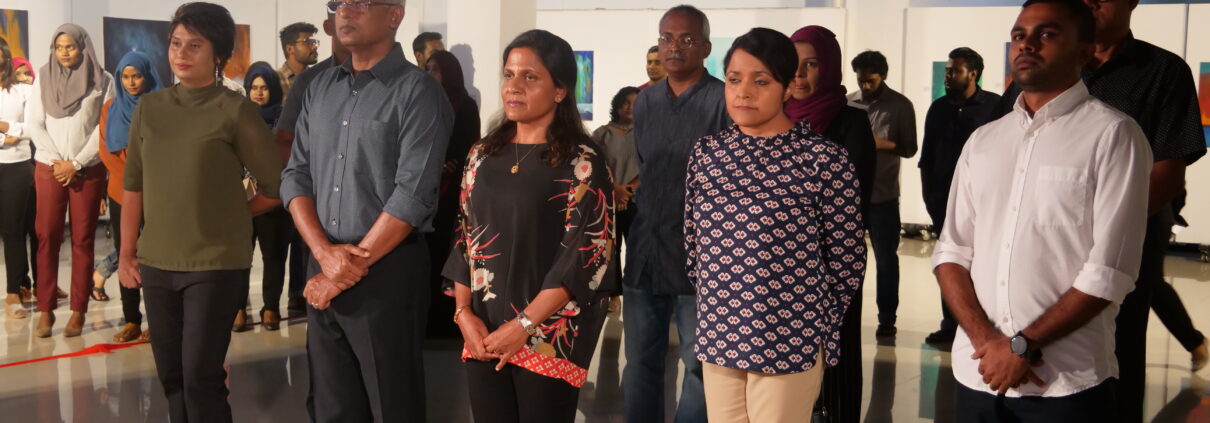
The exhibition was officially inaugurated on April 12th by the President of the Maldives, with the First Lady, the Minister of Arts and Culture, and senior government officials in attendance. Having the highest level of support gave the event a sense of national importance something I felt deeply grateful for. The exhibition remained open to the public until April 15th.
Art and Environment: A Personal Commitment
This project began with months of quiet research and reflection. I immersed myself in climate science, read reports, and thought about how the Maldives the place where I was born was uniquely vulnerable. Being the flattest and lowest-lying country in the world, the Maldives stands at the frontline of sea level rise. I felt an artistic and personal responsibility to respond.
Some of the paintings in the exhibition celebrated the Maldives’ radiant natural beauty — the sea, the skies, the rhythm of the islands. Others quietly disrupted the calm: high water marks, vanishing coastlines, submerged coconut palms. Each painting in the exhibition was designed to start a conversation. I wanted viewers to feel a connection not only to the landscapes I painted, but also to the urgency of protecting them.
The exhibition space became a creative ground for awareness and contemplation. A projector played a short documentary that traced my artistic journey, allowing visitors to understand the person behind the work and what had led me to this moment.
When Art Opens Dialogue
During the opening, I had many conversations with visitors about the process, the time it took, and the reasons behind creating such a large-scale body of work. What stood out most were the personal reactions especially from young women who told me how meaningful it was to see a large-scale exhibition on climate change led by a female artist. Several of them shared how it made them feel proud and represented. These conversations and meaningful expressions stayed with me.
Conversations like that reminded me why I make art: not only to express, but also to connect. It is not always about offering answers, but about creating space for shared reflection and discussion.
The Role of Artists in a Changing World
This exhibition wasn’t only a display of paintings. It was also a space to raise questions — ones I still carry with me:
- What role can artists play in climate awareness?
- How can creative practices help recover local knowledge and values?
- How can we bring together art, activism, and local knowledge?
- Can art help people feel — not just understand — the stakes of environmental change?
These questions shaped both the exhibition and the dialogue that followed.
A Quiet Milestone
The exhibition received widespread attention, with coverage in over 14 local newspapers and a feature on national television. But more than press, what I remember most are the quiet moments in the gallery — the conversations, the personal stories, and the feeling of seeing the work resonate with others, especially in the place that inspired it.
Looking back, this project asked a lot of me. But it gave me something in return: a deeper understanding of what it means to create with care, and a quiet belief that art can be both beautiful and purposeful. It can bridge the gap between fact and feeling.
As an artist, I believe I have a responsibility to engage with the times we live in. This project allowed me to do that in the most personal way.

